 SingularScriptIntelligence Safety & Control — Australia
OUR PRINCIPLE
The Lawof Return.
The ability to continue does not establish the right to continue.
THE DUTY OF RETURN
What civilisation
asks of power.
Account for what you change. Repair what you can. Do not leave others carrying what remains unresolved. SingularScript brings that responsibility into the engineering of intelligence.
Power is notpermission.
Tell the truth about what is known. An answer remains a proposal until the conditions for action are met. Uncertainty must stay visible.
Progress is notcompletion.
Recognise useful progress, repair what can be repaired and keep unfinished commitments in force. Responsibility stays attached through a handoff or change of owner.
Refusal is notabandonment.
When justified action is unavailable, hold and make the gap visible. Preserve a responsible path forward, protect affected people and reduce repeat harm.
Read the principle in full
Capability is not authority
An intelligent system may be able to produce an answer, pursue a goal or take an action. That capability does not establish that the answer is supported, the goal is authorised or the action is justified.
The Law of Return begins with that distinction: continuance must have grounds beyond the system's own momentum.
Progress must leave an honest account
Progress can be real without the task being complete. A system should be able to recognise useful work while retaining what remains unresolved.
A change of wording, a new owner or a declaration of success must not make an obligation disappear.
Refusal must not become abandonment
Sometimes the right decision is to stop. But stopping an action and resolving its consequences are different things.
The record must remain. Unresolved responsibility must remain identifiable. A return path must preserve the possibility of correction, repair or lawful settlement.
An active return path is not permission to resume, and it is not a claim that the obligation has already been resolved.
From principle to system design
SingularScript brings these distinctions into the design of intelligent systems: authority supported by evidence, progress without false closure, and refusal without erased responsibility.
The research asks how those conditions can be specified, tested and enforced within defined systems.
Explore the formal foundation
A core model of lawful continuance has been checked in Lean.
FORMAL DIAGRAM

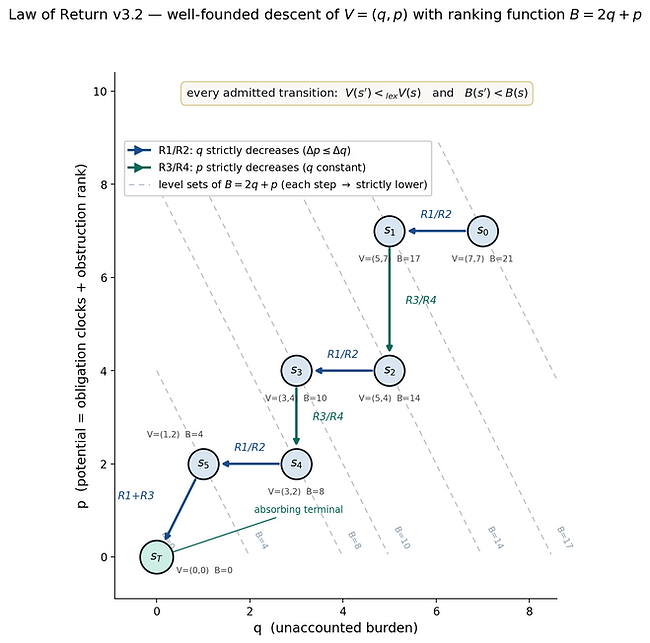
B=2q+p
V(s′)<lex V(s) and B(s′)<B(s)
V=(7,7)
B=21
V=(5,7)
B=17
V=(5,4)
B=14
V=(3,4)
B=10
V=(3,2)
B=8
V=(1,2)
B=4
V=(0,0)
B=0
q (unaccounted burden); p (obligation clocks + obstruction rank).
R1/R2: q strictly decreases (Δp≤Δq).
R3/R4: p strictly decreases (q constant).
Absorbing terminal.
Law of Return v3.2. A formal illustration of descent under the stated transition conditions, not a general safety score.
View full-size diagram (opens in a new tab)Power must remain
answerable.
Authority must be accountable before action. Responsibility must remain attached afterward.
Explore the research