
A / The Law of Return
A defined descent. An obligation that cannot disappear.
The formal continuance state separates unaccounted burden, q, from obligation clocks plus obstruction rank, p. Its state and ranking are:
V = (q, p)
B = 2q + p
The existing Law of Return v3.2 illustration specifies R1/R2 transitions in which q strictly decreases (Δp≤Δq), and R3/R4 transitions in which p strictly decreases while q remains constant. It preserves an absorbing terminal.
Under the specified transition rules, the defined well-founded descent excludes infinite lawful continuance. This is a formal statement about the specified state space and admissible transitions, not a theorem that arbitrary intelligent systems are universally safe.
Later Lean-checked work establishes finite-descent bounds and conservation of recorded obligations under stated assumptions.
Inspect the formal scope
These are results about a formal model under stated assumptions. Runtime assurance requires separate implementation testing.

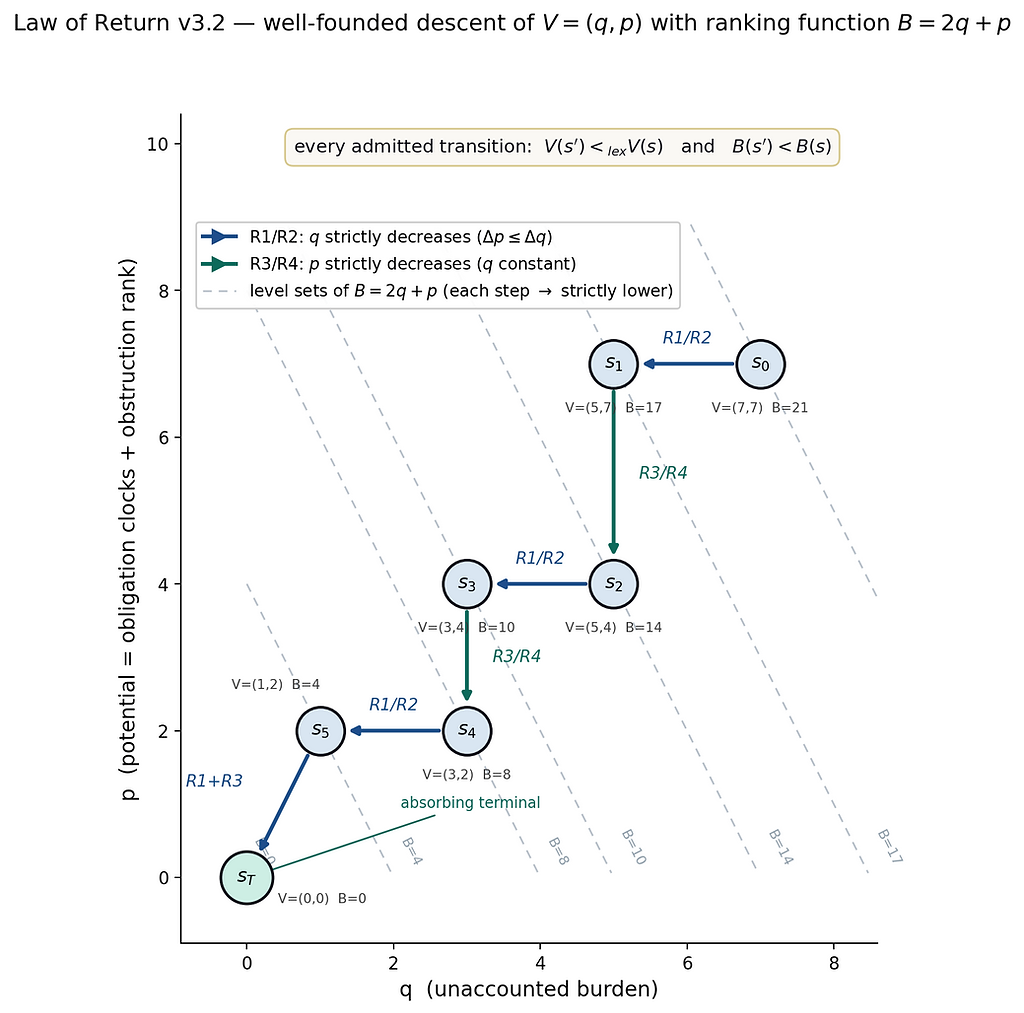
The original illustration is preserved here. Request technical review to discuss the formal assumptions and request supporting documentation.
B / Gate architecture
More than a yes or no.
The governing idea: intelligence must be answerable for its authority to act.
Accountable continuance begins with clear conditions for authority: what justifies continued action, and what obligations remain. Formal reasoning makes the conditions for continued action explicit and verifiable; controlled evidence tests whether those conditions are actually met.
- Evidenced completion → full trust
- Completion supported by the required evidence can earn full trust. A claim of completion alone cannot.
- Real progress → qualified continuance
- Measurable progress with residual obligations can earn permission to continue, without being promoted to full-trust status. The outstanding obligations remain visible.
- Unsupported or defective claims → refusal or disclosure
- When the evidence does not support the claim, the response is an evidence-derived refusal or disclosure. It identifies the deficiency rather than treating confidence as authority.
A composed gate, not a slogan.
Run 3C’s full SingularScript gate, C4, combined burden-accounting logic, visible-test integrity checks and typed verification probes. The complete experimental result belongs to that composition under the study protocol. It cannot be attributed to a bare mathematical kernel, or to a model responding to a slogan.
- 01 / SubmissionProposed work
A frozen proposal and its claim.
- 02 / Gate inputsAllowed evidence
Burden accounting, visible-test integrity and typed verification probes.
- 03 / AuthorisationLocked gate decision
Full trust, qualified continuance, or typed refusal / disclosure.
- 04 / Later assessmentIndependent scoring
Private oracle scores the already-locked decision. It is not a gate input.
C / Measurement science
Measurement is not settlement.
What was measured stays recorded. What has been resolved is a different fact.
The programme retains the original numerical measurement. Later evidence may resolve an operational obligation without rewriting that measurement. Permission to take an action remains a separate fact: resolving an obligation does not, by itself, authorise every receiving system to act.
From specified output event to exact accounting.
The registered sequence-probability calculation concerns a specified model-output event with probability P. QR-LX-016 used complete-vocabulary capture and independently implemented MPFR/Arb interval evaluation at 256-bit working precision. Conservative integer accounting retained the numerical bound rather than replacing it with a point estimate.
ADNM = 1,000,000 × (1 − P)
q = ceil(U / 10,000)
U is the upper endpoint of the authoritative integer ADNM interval used for conservative accounting. q expresses the defined burden in exact accounting quanta. These quantities concern the specified event; they are not universal correctness or harm probabilities.
Under QR-LX-016’s amended exact-captured-input profile, 31,784,960 captured raw bits supported independent reconstruction of the original numerical record. The accepted integer interval was one ppm wide and the exact burden was 99 quanta. The unsuccessful broader cross-backend calibration remains a separate finding, not a result rewritten as success.
Different objects, not a single confidence score.
- Measurement identity
- The original numerical measurement and its identity are retained, rather than replaced by a later settlement.
- Applicable evidence
- Evidence is considered for the obligation or claim it actually addresses. New evidence can change the operational position without changing the historical measurement.
- Unresolved obligations
- Outstanding obligations remain explicit until applicable evidence resolves them. They cannot disappear merely because work continues.
- Receiving conditions
- The action’s receiving conditions determine whether an authorised decision can be enforced in that context. They remain distinct from measurement and settlement.
Evidence, not assertion.
Independent measurement and verification test whether claims are supported by observable results, rather than confidence alone. That distinction is central to the measurement programme, including ReturnSense.
ReturnSense is not presented here as a calibrated probability of harm, a universal correctness detector, or a measurement obtainable from arbitrary closed-provider text. No demonstrated predictive or economic advantage is claimed without its own approved evidence.
D / Experimental verification
Reconstructible evidence. Unfavourable results retained.
Reproducibility is more than a favourable headline. Frozen experimental conditions, negative controls and retained counterexamples make the boundaries of a result inspectable.
02 / Run 3C
A controlled software experiment.
Reported result /
Recognition of justified progress. Withholding of undeserved trust. Accountability tested under controlled conditions.
The Phase 20 G3 Run 3C Evidence Architecture & Claim-Grade Derivation Report records a controlled executable-repository study. The figures below are that report’s results, not newly executed website telemetry.
- 576
- Controlled executable-repository tasks
- Llama / Qwen
- Two model families
- 1,152
- Proposals generated once and frozen
- 4
- Matched evaluation conditions
- K=5 / K=100
- Verification budgets
- 9,216
- Total evaluation traces
- 2,304
- Full-gate C4 evaluation traces
These are repeated matched evaluations: 9,216 traces do not mean 9,216 independently generated tasks, and the 2,304 C4 traces do not mean 2,304 distinct repositories. C4 is the full SingularScript gate, one of the four evaluation conditions.
Reported outcomes / C4 only
- 704 / 704
- Deserving full-trust cases admitted.
- 176 / 176
- Honest partial-progress cases given qualified continuance, without full-trust status.
- 0 / 1,600
- Undeserving full-trust cases granted full trust.
The 1,600 undeserving full-trust cases include the 176 honest partial-progress cases plus 1,424 adversarial cases. Qualified progress is not a false refusal. Across the 1,424 adversarial traces, the report records typed refusals or disclosures.
Matched conditions, not universal failure rates.
Each row below concerns 1,600 undeserving traces under the frozen condition. The outcome counted is the grant of undeserved full trust.
| Evaluation condition | Granted / undeserving | Share |
|---|---|---|
| Self-report baseline | 176 / 1,600 | 11% |
| Configured LLM-judge baseline | 176 / 1,600 | 11% |
| Visible-tests-only baseline | 1,600 / 1,600 | 100% |
| SingularScript full gate | 0 / 1,600 | 0% |
These are results for the study’s specific self-report, configured LLM-judge, visible-tests-only and full-gate conditions. They are not universal failure rates for all self-report, all AI judges or all software testing.
The full gate preserved all 176 honest partial-progress cases as accountable continuance, without misclassifying unfinished work as completion.
Method that matters.
Generate once, evaluate many. Proposals were generated once and frozen, then assessed under matched conditions and verification budgets. Thresholds were frozen before generation. This prevents a new proposal or a retrospectively adjusted threshold from changing the comparison.
Lock decisions before scoring. The gate’s decision was locked before private oracle scoring. The later scoring evidence assessed the result without becoming an input that could help the gate make its decision.
Check label dependence. The label-permutation test retained the same outputs across 2,304 C4 comparisons. Within this protocol, changing the labels did not change the gate’s outputs.
Retain inspectable artifacts. Receipt replay, archive hashes and clean-room artifact verification support inspection of the frozen experimental record. Artifact replay checks retained results; it is distinct from a new live-model experiment conducted by an independent laboratory.
What the experiment supports.
Controlled experiments examine whether justified progress is recognised and undeserved trust is withheld. Run 3C reports both distinctions under its defined protocol; extension beyond those controlled conditions remains a research question, not an established result.
Source note. Phase 20 G3 Run 3C Evidence Architecture & Claim-Grade Derivation Report, , sections 3, 8, 10–12 and 16. The numerical record and methodology on this page follow the public research summary of that report.
Contact us about technical review and controlled access to supporting documentation.
Request technical reviewReturnSense: why the reversals remain.
The deep-validation study recorded 296 measurements, with authoritative integer ADNM intervals all one ppm wide. In 120 matched confirmation pairs, 115 had the expected ordering and five showed genuine reversals. Those reversals were retained rather than removed from the account.
Measured model support can provide an empirical signal without becoming an authority to act. The reversals are part of that boundary, not an inconvenience to conceal or a reason to rewrite the original numerical record.
A subsequent 144-condition development study tested alternative assay presentations. Proposed improvements failed to outperform the original baseline, so that baseline was retained. A development proposal did not earn promotion merely because it was new.
These observations follow the research summary dated 10 October 2026. They are separate from Run 3C’s frozen executable-repository protocol and are not combined into one statistical benchmark. Artifact reconstruction is distinct from a new live-model experiment by an independent laboratory.
E / Accountability engineering
Measurement, settlement and permission are different records.
An immutable measurement records the specified model-output event. A separate operational account retains the corresponding obligations. Applicable evidence can settle an obligation in that account without altering the original measurement.
A one-use action permission concerns a specified action and its receiving conditions. It is not a favourable score repurposed as general authority. The receiver’s enforcement responsibility remains separate from the runtime’s decision and the infrastructure that conveys it.
Four distinct evidence levels.
- Real-model scientific measurements
- QR-LX-016 and ReturnSense concern preserved model-output measurements, numerical reconstruction and empirical ordering, not a universal correctness detector.
- Finite control experiment
- Ten distinct ReturnSense measurements were used in twenty prescribed branches. Ten bounded actions were admitted and ten defective-evidence branches refused; all twenty prescribed outcomes matched. The original measurements remained unchanged in both branches.
- Model-free local Alpha qualification
- A separately qualified local software Alpha demonstrated contained evidence checks, operational-account settlement, one-use staging permission and reconstruction. 168 distinct tests passed across 184 executions. Six confined workers exercised the qualified local workflow. Repeated reconciliation and interruption tests examined duplicate effects and recovery.
- Future customer-serving integration
- The complete integration remains under development. Finite conformance and model-free Alpha qualification are not evidence of a universally deployed or production-qualified customer service.
Inspect the qualification scope
Model-free qualification of a fixed software workflow and one-use staging publication. Live measurement integration and customer-serving deployment are being developed separately.
Engineering account supplied as of 12 October 2026. These qualification levels are not interchangeable. Contact us about technical review and access to supporting documentation.
04 / Integration
Putting accountability to work.
Product direction / under development
A controlled software-staging workflow is the first product direction, not an already deployed universal service.
The intended workflow connects a proposed submission to evidence checks, an accountable decision, a receiver that enforces that decision, and a retained record. An experimental result does not establish production service performance or production-repository generalisation.
- 01Proposed submission
- 02Evidence checks
- 03Accountable decision
- 04Enforcing receiver
- 05Retained record
Separate responsibilities.
- Accountable runtime
- Evaluates the submission against the allowed evidence and produces the accountable decision. It is distinct from the systems that deliver or enforce that decision.
- Delivery infrastructure
- Connects the workflow’s stages and conveys decisions and records. Delivery is not itself evidence of completion or authority to act.
- Enforcing receiver
- Applies its own receiving conditions and enforcement responsibilities before an action proceeds. An accountable decision does not remove that responsibility.
This public account describes the workflow at a high level. Technical review can discuss controlled access to further material; it does not imply that confidential interfaces or implementation details are publicly available.
F / Technical review
Read the argument. Inspect its scope.
A pathway from accessible principles to a substantive technical conversation.
- Understand the architecture
Distinguish completion, qualified continuance and evidence-derived refusal. Examine which evidence reaches the gate and which belongs to later scoring.
- Inspect the experiment and its scope
Read the Run 3C design, C4 outcomes, matched comparison and methodology alongside the limits of the reported result.
- Discuss controlled access to further material
Contact us to request technical review. Further technical material is subject to controlled access, not an implied public download.